This weekend I had the pleasure of reading Technological Revolutions and Financial Capital by Carlota Perez. Every once in a while you encounter a book that was written a while back that feels like it could have been written yesterday. Granted, 2002 isn't that long ago, but given the topic, it's been quite a ride since then and this book could not be more relevant and fresh. A lot of what Perez lays out will feel familiar because it filtered from economists to Andreessen Horowitz to journalists to LinkedIn Influencers who have been happily regurgitating her ideas for years now.
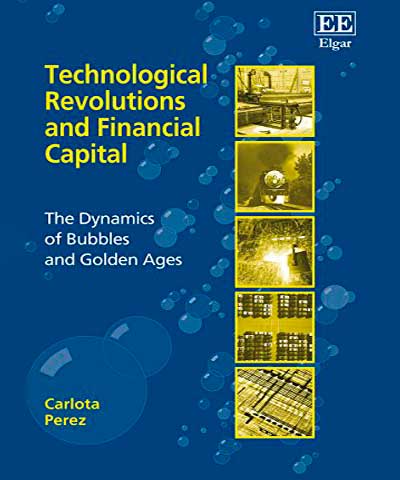
She's the most coherent origin of the idea that a technological revolution isn't just a new technology, it's a cluster of interconnected technologies, industries, infrastructures, and organizational practices. Most importantly, because financial models and institutions don't adopt the technology at the same rate, you get (in order) frenzy, bubble, crash, then utility. It's been happening since the 1700s and the pattern has played out again and again in extremely similar ways since then.
"What begins promising a golden age ends up in economic trouble and intense political confrontation. Both will contribute to the coming together of the next technological revolution and the cycle will begin all over again in another unique and specific manner". Not all crises are the same but all share similar patterns. History rhymes rather than repeats and her book is less a roadmap than a typology of states that lead to one another. That said, the history is well researched and sharply observed and she describes the cycles that she observes in great detail.
The Cliffs Notes version of her model of the lifecycle of a technological revolution:
| Irruption | New technology breaks into the existing economy | Finance rushes toward new opportunities |
| Frenzy | Speculation and rapid investment accelerate | Financial capital becomes increasingly detached from productive value |
| Turning Point | Bubble bursts / crisis occurs | Institutions are forced to change dramatically |
| Synergy | Technology diffuses throughout the economy | Finance and productive capital become more aligned |
| Maturity | Technology reaches saturation and returns diminish | Capital starts searching for the next revolution |
The technology part of the story is well known at this point to anyone who is unfortunate enough to listen to tech-ish podcasts or have a LinkedIn account, but Perez also thinks through what capital does and that is much more interesting in my opinion. She divides capital into financial capital and productive capital or, put very simply, "I invest in building X because it might work and be profitable" and "I invest in X because X is built, works, and is profitable". Financial capital is focused on liquidity, exchangeability, optionality, where production capital focuses on the more material stuff of manufacturing, processing, and operating. Financial capital often seeks to upend institutions, productive capital seeks to reinforce them. What makes a technological revolution in her telling isn't only the technology, it's how capital responds to that technology.
Productive capital operates primarily on stuff. Financial capital operates primarily on information. That inflates the value of information in ways that are useful in what Perez calls the 'irruption' phase of a technological revolution, when a new technology appears along with the conditions to put it to use. The also inflates it ways that aren't useful, during what she terms the 'frenzy' phase, where speculation outstrips the actual productive possibilities of a technology and becomes a bubble. Information about a new railroad line isn't a functional rail-line ready for locomotives but if you can make an astronomical profit by betting on it, it might be worth the gamble. Multiply this across an entire economy and you get a bubble. Get a large enough bubble and people realize that not all of them can make the promised astronomical profits.
Innovations in technology often require an innovation on the economic side as well to become anything other than a neat new idea or fancy widget. Without the joint-stock company there is no railroad. While Edison could get financing for his experiments at Menlo Park from JP Morgan himself, building thousands of kilometers of rail required something bigger that could distribute the risk it was taking in building infrastructure. The financial innovation to build the railroads was the source of the entire rail network and of the catastrophic economic crash in 1873. What creates a Golden Age is what Perez calls "The Socio-Institutional Framework" being reshaped from the old paradigm to the new one and the broad growth and prosperity afforded by the deployment of that technology via productive capital. That productive capital innovates as well, finding new ways to form institutional arrangements and eke out gains from mature industries.
Bubbles Today
"Frenzy is thus a time when the rich get richer and the poor get poorer. Financial capital enters this polarized stage as an accelerator of the centrifugal forces."
Everyone who touches AI or computing in any capacity is wondering if we're in a bubble. Part of what made this book so appealing to me was the subtitle: "The Dynamics of Bubbles and Golden Ages". While I can't read Perez's mind and she's hasn't weighed in anywhere that I can find, it seems like the answer would be yes. Finance capital is sloshing around in ways that seem silly even to those doing the sloshing, inequality is astronomically high, grifting is a way of life, and the threat of "missing out" seems to have infected even the most sober of investors. Also, Perez tells us that the crash would actually the way to actually realize the potential of the technology and provide an opportunity to put it to good use for the broader society.
In Technological Revolutions and Financial Capital, Perez says that the re-coupling of financial capital and productive capital occurs after the bubble pops and is driven by institutions and regulation. That's the pattern that leads to what she terms the "Golden Age" of the sub-title: technological maturity is achieved, instiutional stability reigns, the benefits are shared. That Golden Age however is never guaranteed. The crash of 1929 that made The New Deal and laid the foundations of the prosperity of the 1950s and 60s in the United States also made Nazi Germany and the millions of deaths in the Soviet Union. The Global Financial Crisis of 2008 bequeathed us no new significant institutions, only crypto-currencies and populist discontent.
A proposition I hear is that AI itself is a new technological revolution. Again, without being able cite Perez herself on this, it seems her answer would be no. It's simply a further iteration of what was begun in the 1970s. The 70s and 80s gave us the chips, the 90s laid the cable, the 10s gave us the institutions and the social conditions. The data center boom and AI may even be the last iteration of that particular technological revolution. What that means is that it might be what asks those of us living in speculative capitalism (by choice or not) to reckon with the aftermath of the frenzy.
In the book, what creates a bubble is financial capital seeking ways to slip away from the staid boring gains of productive capital, the rules and regulations of the old order seeming restrictive and inefficient, the old ways of doing things becoming inadequate. Part of this is a mismatch of the Socio-Institutional Framework to the new technology. The Golden Age comes from the re-coupling of production and finance and an adaption of institutions or the wholesale creations of new ones. It's hard to believe that we in the West have the institutional capacity and long-termism that build a Golden Age from a Bubble today. So it seems more likely than not that the crash will necessitate building those institutions rather than leveraging them. That doesn't damn us to a horrible fate but it certainly contains risks: nothing guarantees those institutions won't be backward-looking fascists or a ruthless self-interested oligarchy.
Updating the model
This book is from 2002 and since then Perez has applied her inquiry and thinking to a several new arenas, most interesting of which is one that barely existed as a broad concern 25 years ago: climate change. Technologies without a framework of broad social utility are napkin sketches, science projects, toys. Our era has gifted us a broad and profound measure of utility: reducing resource extraction and mitigating the effects both of climate on humans and of humans on climate. Her contribution to an anthology called Rethinking Capitalism is Capitalism, Technology and a Green Global Golden Age and it's an updating of TRFC that gives an optimistic lens on where we may be going.
She claims we're at the Turning Point between the Installation and Deployment phases of the fifth technological revolution. The infrastructure of the previous technological revolution was built on limitless and consequence-free resource extraction. The infrastructure of the current technological paradigm may be built to reduce the resource intensity of production and consumption. That certainly isn't what we see in the data center buildouts happening across the United States but the US may no longer be the standard-bearer for new technological deployment that it once was. Her vision of a IT-led Green Future is an anathema to the Petro-dollar regime but also one of the only economically viable forward-looking visions out there. I can only hope that she's right.